
Why Source Mass Reduction Should Come Before Plume Treatment
Are you treating the dissolved plume while NAPL is still feeding it?
When significant NAPL remains in the subsurface, it can continue acting as a source of contaminant mass to groundwater. That means treating dissolved-phase contamination, without adequately addressing the source, may leave your remediation program working against continued contaminant loading.
NAPL is the source.
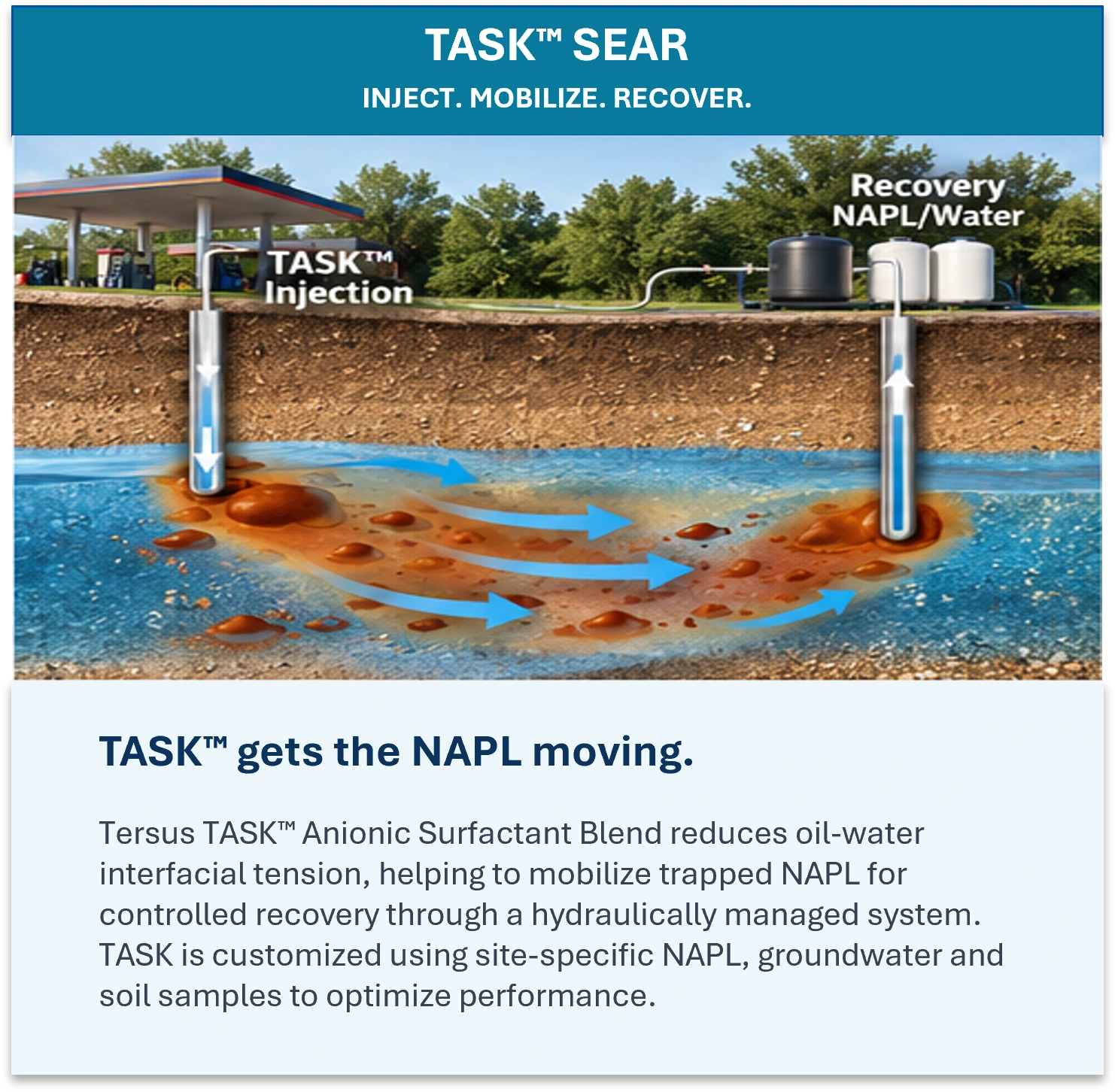
NAPL can remain trapped within the formation because of capillary forces and poor aqueous solubility. As long as significant recoverable NAPL remains, it can continue contributing contaminant mass to groundwater. TASK™ formulations reduce oil-water interfacial tension so trapped NAPL can be mobilized and recovered with hydraulic control.
Dissolved-phase treatment doesn't necessarily eliminate the source.
You can treat the dissolved phase with bioremediation, oxidation, sorption, or other technologies, but they only manage the symptoms if a NAPL source continues to contaminate the groundwater.
TASK™ attacks the source-management problem first.
TASK™ Anionic Surfactant Blend is used within a hydraulically controlled SEAR system to mobilize and recover separate-phase contamination. Tersus tailors formulations using site-specific NAPL, groundwater, and soil samples to minimize interfacial tension, target favorable phase behavior, and create fast-breaking emulsions that simplify recovered-fluid separation.
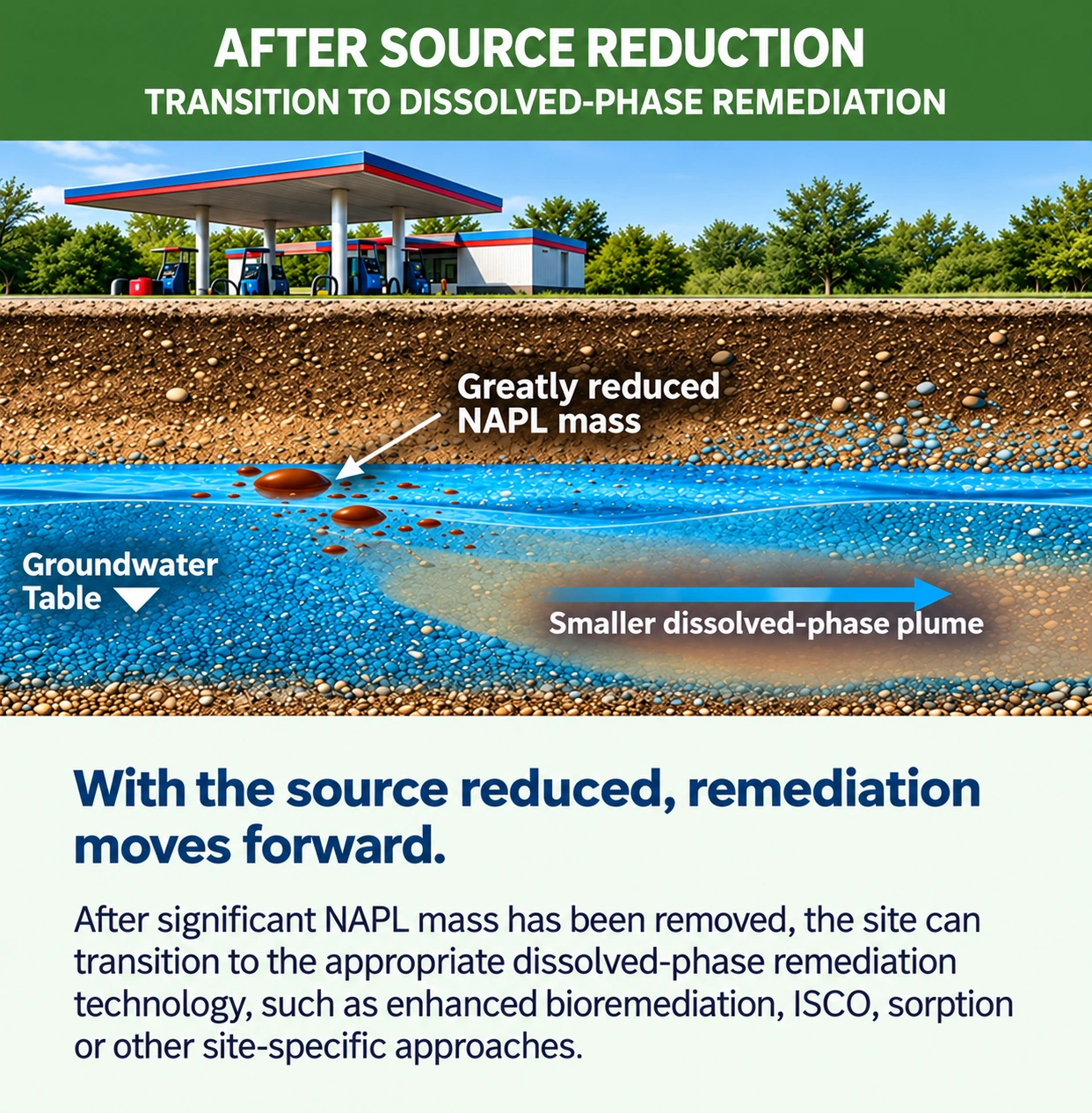
Then transition to dissolved-phase remediation.
Once source mass has been substantially reduced, the project can transition to the appropriate polishing technology such as enhanced aerobic bioremediation, anaerobic bioremediation, ISCO, in situ sorption/biodegradation, or another site-specific approach.
|
Application & Delivery
TASK™ Anionic Surfactant Blend is shipped as a concentrated formulation and typically diluted with water to 0.5–2% prior to injection, depending on site conditions and laboratory testing results. Injection and extraction are performed under controlled hydraulic gradients to ensure capture of mobilized NAPL.
Application rates, surfactant concentrations, and flushing volumes are site-specific and based on NAPL characteristics, groundwater chemistry, and formation properties.
Complimentary Site Evaluation
Unsure whether Surfactant-Enhanced Aquifer Remediation (SEAR) is appropriate for your site? We can review the contaminants, groundwater geochemistry, treatment area, and remediation objectives.
Want to talk first? Reach out to us so we can discuss your site before submitting an evaluation form. Collaboration is key.
