
Case Study Highlights
A petroleum-impacted site in Ontario presented a groundwater source-attribution challenge involving a documented historical petroleum release and a suspected second release within the original impacted area. Extensive biodegradation had occurred, making it difficult to distinguish the potential releases using conventional contaminant concentration data alone.
Tersus Environmental supported a forensic investigation using carbon isotope analysis of dissolved inorganic carbon (DIC) and compound-specific isotope analysis (CSIA) of selected petroleum hydrocarbons. The investigation combined isotope measurements from eight monitoring wells with historical groundwater monitoring data to evaluate whether the contamination patterns were consistent with two separate petroleum sources.
Investigation Approach and Technologies
- Dissolved Inorganic Carbon (DIC) Isotope Analysis: Carbon isotope ratios (δ¹³C-DIC) measured in groundwater from eight monitoring wells to evaluate differences in petroleum impact signatures.
- Compound-Specific Isotope Analysis (CSIA): Carbon isotope analysis of ethylbenzene, m,p-xylene, and o-xylene performed on groundwater samples from MW-2 and MW-13 to investigate petroleum source relationships.
- Petroleum Hydrocarbon Characterization: Groundwater analyzed for benzene, toluene, ethylbenzene, and xylenes (BTEX), along with petroleum hydrocarbon fractions F1 (C₆–C₁₀) and F2 (C₁₀–C₁₆).
- Historical Data Evaluation: Isotope measurements compared with historical petroleum hydrocarbon concentrations to assess spatial differences in contamination and potential source relationships.
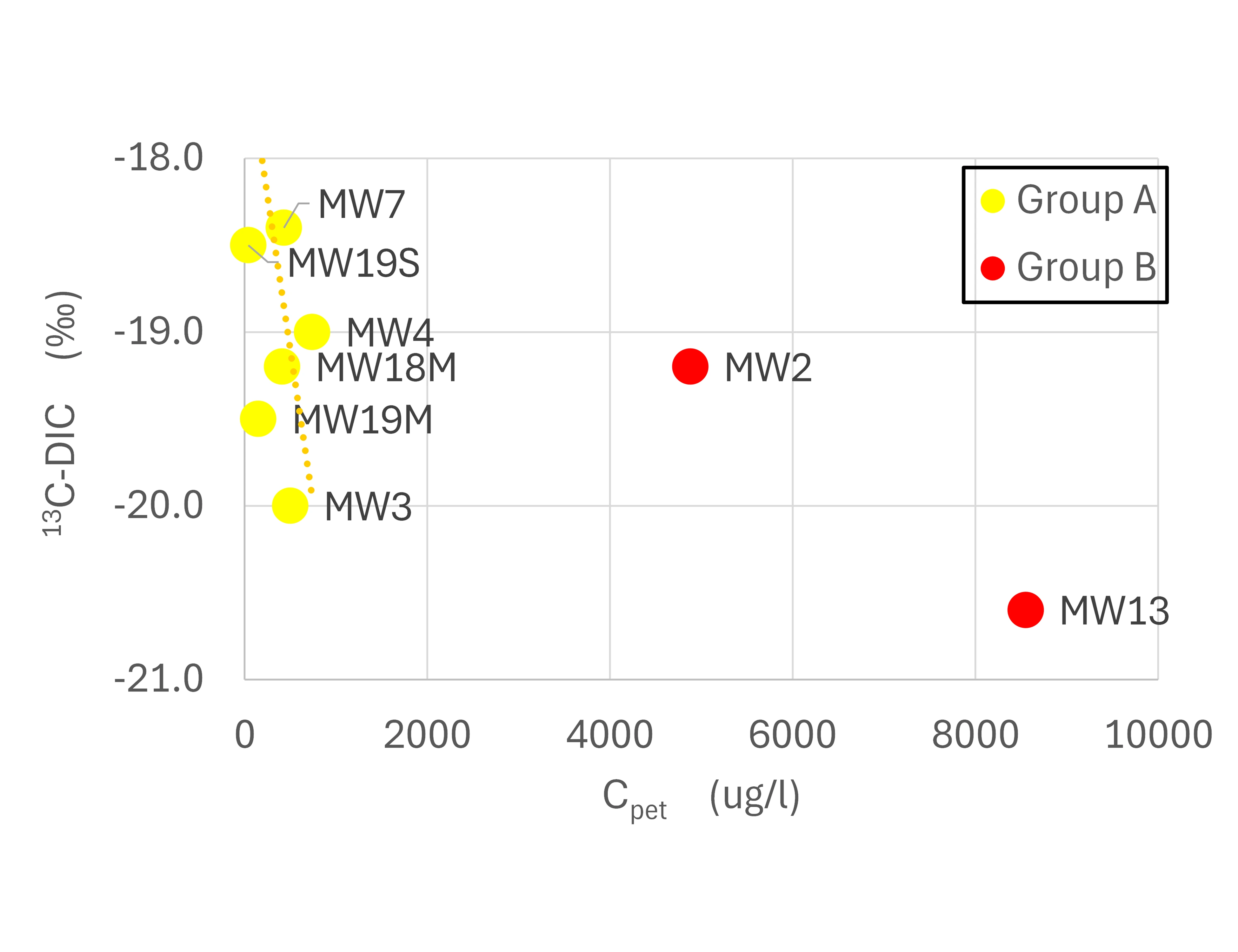
- Forensic Interpretation: Monitoring wells classified into two groups based on their DIC isotope signatures and historical petroleum impacts, providing evidence consistent with separate petroleum sources.
- Technical Support: Tersus provided remote sampling support and interpreted isotopic data in the context of the site's existing characterization and groundwater monitoring records.
The investigation identified two distinct monitoring well groups. Group A included six wells associated with a broader historical petroleum impact, while Group B consisted of MW-2 and MW-13, representing a more localized area with different isotopic characteristics.
CSIA results from MW-2 and MW-13 were consistent with a common petroleum source affecting both wells. Together, the DIC isotope and CSIA findings supported the interpretation of two petroleum impacts, providing additional evidence for evaluating the site's contamination history.
Project Benefits
Combining DIC carbon isotope analysis with targeted CSIA provided additional forensic evidence to evaluate potentially separate petroleum sources at a site affected by historical groundwater contamination. The investigation helped distinguish contamination patterns that were difficult to interpret using conventional concentration measurements alone.
Benefits of the Forensic Investigation
- Differentiation of Petroleum Impacts: DIC isotope analysis identified two distinct groups of monitoring wells with different petroleum impact signatures, providing evidence consistent with separate petroleum releases.
- Improved Source Attribution: CSIA results for ethylbenzene and xylene isomers supported a common petroleum source affecting MW-2 and MW-13, helping characterize the localized impact within the broader contaminated area.
- Integration of Historical and Current Data: Combining isotope measurements with historical petroleum hydrocarbon concentrations provided additional context for interpreting contamination patterns and source relationships.
- Targeted Analytical Approach: DIC isotope measurements from eight monitoring wells were supplemented by CSIA at two wells where contaminant concentrations were sufficient for analysis.
- Independent Lines of Evidence: DIC isotope analysis and compound-specific isotope measurements provided complementary information to support the evaluation of potential petroleum sources.
- Support for Future Site Decisions: The forensic findings provided additional information for site characterization, potential responsibility discussions, and subsequent investigation or remediation planning.
Project FAQs
The site had a documented historical petroleum hydrocarbon release, and a second release was suspected within the original impacted area.
Because extensive biodegradation had occurred, conventional groundwater concentration data alone could not readily distinguish the potential releases. Carbon isotope analysis of dissolved inorganic carbon (DIC) and compound-specific isotope analysis (CSIA) were used to provide additional forensic evidence of petroleum source relationships.
Petroleum hydrocarbon biodegradation produces carbon dioxide (CO₂), which contributes to dissolved inorganic carbon in groundwater. The carbon isotopic composition (δ¹³C) of this DIC can differ from naturally occurring background DIC.
By comparing DIC isotope measurements with historical petroleum hydrocarbon concentrations, investigators identified two groups of monitoring wells with different isotopic characteristics. These patterns were consistent with separate petroleum impacts.
CSIA was used to evaluate the carbon isotopic composition of individual petroleum hydrocarbons, including ethylbenzene, m,p-xylene, and o-xylene.
Sufficient contaminant concentrations for CSIA were present only in groundwater samples from MW-2 and MW-13. The isotope results were consistent with a common petroleum source affecting both wells, providing additional evidence to support the source-attribution investigation.
The DIC isotope analysis identified two distinct monitoring well groups.
Group A included six wells associated with a broader historical petroleum impact. Group B consisted of MW-2 and MW-13, which exhibited different isotopic characteristics within a smaller, localized area.
The investigation also estimated a natural DIC carbon isotope baseline of approximately −17‰. Combined with the targeted CSIA results, the findings supported the interpretation of two petroleum impacts consistent with separate sources.
No. The isotopic evidence was consistent with two petroleum sources, but it did not independently establish the timing or identity of the suspected releases.
The investigation provided additional forensic evidence to complement existing site characterization data. These findings can support further investigation, evaluation of potential source responsibility, and future remediation planning.
Project Snapshot
Location: Ontario, Canada
Site Type: Petroleum-impacted soil and groundwater
Contaminants: Petroleum hydrocarbons (BTEX; F1 and F2 fractions)
Project Type: Environmental Forensics and Petroleum Source Attribution
Investigation Technologies: Dissolved Inorganic Carbon (DIC) Isotope Analysis and Compound-Specific Isotope Analysis (CSIA)
Sampling Program: Eight groundwater monitoring wells
Target Compounds for CSIA: Ethylbenzene, m,p-xylene, and o-xylene
Technical Support: Remote sampling support and isotope data interpretation
Key Finding: Two distinct monitoring well groups identified, with isotopic evidence consistent with separate petroleum sources
