
Case Study Highlights
A grain storage facility in Wichita, Kansas, required groundwater remediation to address carbon tetrachloride concentrations exceeding 5,000 µg/L in the source area beneath storage silos. The site also contained chloroform and other chlorinated solvent degradation products. Remediation was complicated by a relatively thin, discontinuous aquifer, seasonal groundwater fluctuations, and limited access beneath the silos.
The remediation strategy combined in situ chemical reduction (ISCR) using zero-valent iron (ZVI) with enhanced anaerobic bioremediation and bioaugmentation. Two injection campaigns were conducted to address the source area and downgradient plume. An extensive performance monitoring program used groundwater chemistry, compound-specific isotope analysis (CSIA), microbial gene assays, and tracer studies to evaluate treatment progress and guide subsequent remedial decisions.
Remediation Approach and Technologies
- In Situ Chemical Reduction (ISCR): ZVI delivered using IronGEL™ to promote abiotic reduction of carbon tetrachloride and other chlorinated compounds.
- Enhanced Anaerobic Bioremediation: EDS-ER™ emulsified vegetable oil, EDS-Activator™, Substrate Shuttle™, and supplemental nutrients used to establish and maintain reducing conditions that support biological dechlorination.
- Bioaugmentation: KB-1® PLUS culture containing dechlorinating microorganisms introduced to support biodegradation of chloroform and other chlorinated solvent degradation products.
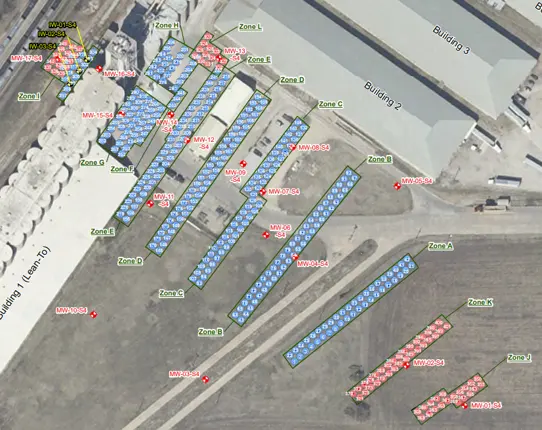
- Subsurface Amendment Delivery: Approximately 270,000 gallons of diluted amendments distributed through 401 direct-push injection points and three permanent injection wells during two treatment campaigns.
- Compound-Specific Isotope Analysis (CSIA): Carbon isotope measurements used to evaluate contaminant transformation and provide evidence of degradation beyond changes in groundwater concentrations.
- Microbial Gene Assays: Molecular biological testing used to monitor Dehalobacter and other dechlorinating microbial populations associated with anaerobic biodegradation.
- Tracer Studies and Groundwater Modeling: Conservative tracers and groundwater flow modeling used to investigate amendment distribution, groundwater transport, and preferential flow pathways.
- Performance Monitoring: Baseline and post-injection sampling included volatile organic compound (VOC) concentrations, geochemical parameters, CSIA, and microbial analyses to assess treatment response across the source area and downgradient plume.
The two treatment campaigns reduced VOC concentrations and the areal extent of the contaminant plume. Monitoring wells near the distal plume and treatment-zone edges were reported to meet applicable screening levels. Plume-center wells showed continued improvement, while remaining contamination in the source area indicated the need for additional treatment.
Performance monitoring through March 2025 helped distinguish treatment responses across the site and provided the basis for targeted recommendations rather than assuming uniform remediation throughout the aquifer.
Project Benefits
Combining ISCR with enhanced anaerobic bioremediation provided complementary treatment mechanisms for carbon tetrachloride and associated chlorinated solvents. The integrated performance monitoring program helped evaluate contaminant degradation, amendment distribution, and differences in treatment response throughout the aquifer.
Benefits of the Combined Treatment Approach
- Complementary Degradation Mechanisms: ZVI promoted chemical reduction of carbon tetrachloride, while enhanced anaerobic bioremediation supported further degradation of chloroform and other chlorinated compounds.
- Reduced Groundwater Contamination: Two injection campaigns significantly reduced VOC concentrations and the areal extent of the contaminant plume, with distal and edge monitoring wells meeting applicable screening levels.
- Targeted Treatment of a Complex Aquifer: Direct-push injections and permanent injection wells allowed amendment delivery across multiple treatment zones, including areas near the storage silos where subsurface access was limited.
- Multiple Lines of Evidence: VOC analyses, CSIA, microbial gene assays, and geochemical monitoring provided complementary information for evaluating treatment performance and contaminant transformation.
- Improved Understanding of Amendment Distribution: Conservative tracer testing identified groundwater transport behavior and injection-related movement that would not have been apparent from contaminant concentrations alone.
- Adaptive Remediation Management: Monitoring results identified differences between source-area, plume-center, and distal treatment zones, helping direct recommendations for additional source-area treatment.
- Evaluation of Treatment Conditions: Geochemical monitoring documented changes in reducing conditions, organic carbon availability, and groundwater pH, providing information to assess conditions supporting chemical reduction and biodegradation.
Project FAQs
The site contained elevated carbon tetrachloride concentrations, along with chloroform and other chlorinated compounds. A combined treatment approach was selected to address the contaminants through complementary chemical and biological processes.
Zero-valent iron (ZVI) was used to promote abiotic reduction of carbon tetrachloride, while electron donor amendments and bioaugmentation were applied to establish conditions supporting further anaerobic biodegradation of chloroform and other degradation products.
The project used 401 direct-push injection points and three permanent screened injection wells across multiple treatment zones.
Approximately 270,000 gallons of diluted amendments were distributed during two treatment campaigns. Direct-push locations received ZVI, electron donor amendments, nutrients, and bioaugmentation culture. The permanent injection wells received soluble electron donors, nutrients, and culture without ZVI.
The injection network was designed to address source-area contamination and the downgradient plume while accommodating access limitations beneath the grain storage silos.
The performance monitoring program combined conventional VOC concentration measurements with compound-specific isotope analysis (CSIA), microbial gene assays, and groundwater geochemistry.
CSIA provided evidence of contaminant transformation through changes in carbon isotope ratios. Microbial assays tracked populations associated with reductive dechlorination, while geochemical measurements helped assess whether groundwater conditions supported the intended treatment processes.
Together, these methods provided a more complete assessment of treatment performance than contaminant concentrations alone.
Conservative tracer tests were used to evaluate the distribution of injected amendments and groundwater transport pathways.
Tracer results helped identify which monitoring wells were influenced by particular injections and revealed movement toward upgradient wells in portions of the narrow treatment zone.
This information improved the understanding of subsurface transport and helped guide the interpretation of groundwater monitoring results.
The project included a comparison of heated and ambient-temperature amendment injections to investigate whether elevated groundwater temperatures could improve biological treatment conditions.
Groundwater temperature modeling was used to evaluate the persistence of injected heat. However, contaminant concentrations in the injection wells had declined to levels that made it difficult to determine whether heated water provided a measurable treatment advantage.
The two injection campaigns significantly reduced VOC concentrations and the extent of the chlorinated solvent plume.
By the reported monitoring stage, distal and edge monitoring wells were meeting applicable screening levels. Plume-center wells showed continued improvement and were projected to meet screening levels within approximately two years without additional intervention.
The source area retained contamination requiring further treatment. Performance monitoring supported recommendations for targeted follow-up remediation rather than additional treatment throughout the entire plume.
Project Snapshot
Location: Wichita, Kansas
Site Type: Chlorinated solvent-impacted groundwater at a grain storage facility
Primary Contaminants: Carbon tetrachloride and chloroform
Other Contaminants: PCE and associated chlorinated solvent degradation products
Remediation Technologies: In Situ Chemical Reduction (ISCR) and Enhanced Anaerobic Bioremediation
Key Amendments: IronGEL™, EDS-ER™, EDS-Activator™, Substrate Shuttle™, TersOx™ Nutrients-QR, and KB-1® PLUS
Injection Program: Two treatment campaigns, 401 direct-push points, and three permanent injection wells
Injection Volume: Approximately 270,000 gallons of diluted amendments
Performance Monitoring: VOCs, geochemistry, CSIA, microbial gene assays, and tracer studies
Project Timeline: Treatment from November 2022 through December 2023; performance monitoring through March 2025
Key Finding: Reduced VOC concentrations and plume extent, with additional source-area treatment recommended
