
Case Study Highlights
A chlorinated solvent-impacted groundwater site in Indiana presented remediation challenges due to low aquifer permeability, complex groundwater flow patterns, and a mixture of chlorinated ethenes and ethanes, including tetrachloroethene (PCE) and 1,1,1-trichloroethane (1,1,1-TCA).
The remediation strategy combined in situ chemical reduction (ISCR) using zero-valent iron (ZVI) with enhanced anaerobic bioremediation. This approach was designed to provide initial contaminant destruction while establishing microbial populations capable of degrading contaminants subsequently released from the aquifer matrix.
Remediation Approach and Technologies
- In Situ Chemical Reduction (ISCR): ZVI ironGEL™ applied to promote chemical reduction of chlorinated solvents in groundwater.
- Enhanced Reductive Dechlorination: EDS-ER™ emulsified vegetable oil, EDS-Activator™, Substrate Shuttle™, and Nutrimens® nutrient blend used to support anaerobic biodegradation.
- Bioaugmentation: KB-1® Plus dechlorinating culture containing Dehalococcoides mccartyi and Dehalobacter used to address chlorinated ethenes and ethanes.
- Compound-Specific Isotope Analysis (CSIA): Carbon isotope measurements used to evaluate evidence of contaminant degradation and distinguish degradation from contaminant desorption.
- Microbial Gene Assays: Quantitative polymerase chain reaction (qPCR) used to evaluate microbial populations and functional genes associated with reductive dechlorination.
The project incorporated two injection events, with the timing of the second injection guided by groundwater monitoring results. Routine volatile organic compound (VOC) analyses were supplemented by CSIA and microbial gene assays at selected monitoring wells to evaluate treatment performance.
Monitoring documented a transition from ZVI-dominated contaminant reduction toward enhanced biological degradation, including evidence that the aquifer could degrade contaminants released through subsequent desorption.
Project Benefits
Combining zero-valent iron (ZVI) with enhanced anaerobic bioremediation provided a treatment approach for a complex mixture of chlorinated ethenes and ethanes in a low-permeability aquifer. Compound-specific isotope analysis (CSIA) and microbial gene assays provided additional evidence of treatment performance and helped guide subsequent remedial activities.
Benefits of the Combined Treatment Approach
- Immediate and Sustained Contaminant Degradation: ZVI provided initial chemical reduction of chlorinated solvents, while enhanced bioremediation established microbial populations capable of degrading contaminants released from the aquifer matrix.
- Management of Contaminant Rebound: Enhanced reductive dechlorination helped address contaminants released through desorption following the initial ZVI treatment, reducing the potential for sustained increases in groundwater concentrations.
- Treatment of Multiple Chlorinated Solvents: The combined approach targeted both chlorinated ethenes, including PCE, and chlorinated ethanes, including 1,1,1-TCA.
- Performance Verification: CSIA provided evidence of contaminant degradation, while microbial gene assays documented the development of populations associated with reductive dechlorination.
- Adaptive Treatment Strategy: Groundwater monitoring results helped determine the timing of the second injection, allowing the treatment program to respond to changing aquifer conditions.
- Targeted Performance Monitoring: CSIA and microbial gene assays were performed at four strategically selected monitoring wells, supplementing routine groundwater sampling while limiting specialized analytical costs.
Project FAQs
The site contained a mixture of chlorinated ethenes and ethanes in a low-permeability aquifer with complex groundwater flow patterns. The remediation strategy combined in situ chemical reduction (ISCR) using ZVI with enhanced reductive dechlorination.
ZVI provided initial contaminant reduction, while electron donor amendments and bioaugmentation supported microbial populations capable of degrading contaminants subsequently released from the aquifer matrix.
Following the initial injection, groundwater monitoring identified increases in certain contaminant concentrations associated with desorption from the aquifer matrix.
The enhanced bioremediation treatment was designed to degrade these contaminants as they entered groundwater. Subsequent monitoring provided evidence that the established microbial populations could reduce contaminant concentrations following these desorption events.
The project combined routine volatile organic compound (VOC) analyses with compound-specific isotope analysis (CSIA) and microbial gene assays.
CSIA provided evidence of contaminant degradation, while quantitative polymerase chain reaction (qPCR) assays measured microbial populations and functional genes associated with reductive dechlorination.
Together, these measurements helped evaluate the contributions of ZVI and biological treatment as remediation progressed.
Groundwater monitoring following the first injection identified signs of contaminants desorbing into groundwater during the fourth quarterly monitoring event.
The monitoring results supported a second injection to address the remaining contaminant mass and reinforce the established treatment conditions. This was the final planned injection event.
The combined treatment approach produced initial contaminant degradation followed by evidence of sustained biological treatment.
Following the second injection, monitoring documented declining contaminant concentrations and evidence of reductive dechlorination. At the reported monitoring stage, eight of the twelve regularly monitored wells had no exceedances, while four wells still had concentrations above applicable criteria.
CSIA and microbial gene assays provided additional evidence that contaminant degradation was occurring and that enhanced bioremediation was helping address contaminants released through desorption.
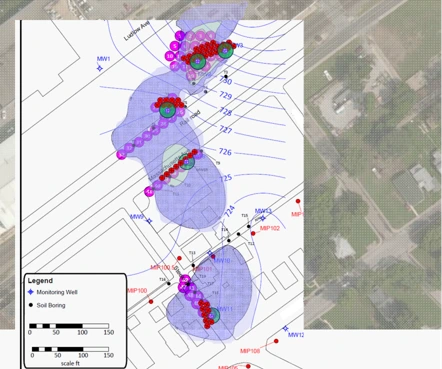
Project Snapshot
Location: Indiana
Site Type: Chlorinated solvent-impacted groundwater
Contaminants: Chlorinated ethenes and ethanes, including PCE and 1,1,1-TCA
Remediation Technologies: ISCR (ZVI) and enhanced anaerobic bioremediation
Key Amendments: ZVI ironGEL™, EDS-ER™, EDS-Activator™, Substrate Shuttle™, Nutrimens®, and KB-1® Plus
Performance Monitoring: VOC analyses, CSIA, and microbial gene assays (qPCR)
Treatment Events: Two injection events
Project Duration: Approximately 2.5 years of treatment and monitoring
