
Reinjectable Permanent Injection Point (PIP) System
Permanent, Selective Injection Systems for Repeated Groundwater Remediation Applications
The Reinjectable Permanent Injection Point (PIP) System is a permanent subsurface injection technology designed to facilitate repeated delivery of remediation amendments to targeted treatment zones. The system combines the advantages of direct-push injection with the long-term accessibility of a permanent installation, allowing remedial amendments to be injected multiple times from the same location without repeated drilling or direct-push mobilizations.
Unlike conventional injection wells, the Reinjectable PIP System utilizes grouted installations and interval-specific injection points to minimize preferential flow pathways and reduce the potential for short-circuiting along boreholes or adjacent well annuli. By forcing injected amendments into the surrounding aquifer matrix, the system promotes improved amendment distribution and more uniform treatment coverage.
The Reinjectable PIP System is particularly well suited for sites requiring multiple amendment applications over months or years, including enhanced reductive dechlorination (ERD), in situ chemical reduction (ISCR), aerobic and anaerobic bioremediation, source area treatment, and groundwater plume management.
Why Use a Reinjectable PIP System?
Many groundwater remediation projects require repeated injections to maintain treatment effectiveness. Traditional direct-push injection methods and conventional screened wells can become costly when the same locations must be revisited multiple times. In addition, screened wells and inadequately sealed boreholes may create preferential flow pathways that result in short-circuiting, uneven amendment distribution, and untreated zones within the treatment area.
The Reinjectable PIP System provides a permanent injection infrastructure that allows:
- Multiple amendment applications from the same location
- Targeted delivery to specific depth intervals
- Improved amendment distribution within the aquifer matrix
- Reduced potential for short-circuiting and preferential flow
- High-pressure injection for increased radius of influence
- Reduced long-term field mobilization costs
- Flexible amendment selection over the life of the project
By eliminating the need for repeated drilling events and improving amendment placement, the system can significantly reduce remediation lifecycle costs while improving treatment consistency and long-term performance.

Key Features
Permanent Injection Infrastructure
Once installed, the Reinjectable PIP System remains available for future injections, allowing treatment strategies to evolve as site conditions change.
Selective Depth Targeting
One-way injection valves can be installed at multiple depths, allowing amendments to be delivered precisely where contamination exists while isolating individual treatment intervals.
IMPROVED AMENDMENT DISTRIBUTION
The annular space surrounding the PIP installation is sealed with impermeable grout, minimizing vertical migration along the borehole and preventing preferential flow pathways. This design forces amendments into the surrounding formation, improving contact with contaminated media and promoting more uniform treatment coverage.
HIGH-PRESSURE INJECTION CAPABILITY
The system supports injection pressures up to approximately 90 bar (1,300 psi), enabling greater distribution and improved amendment contact with contaminated media.
ADVANTAGES OVER CONVENTIONAL INJECTION WELLS
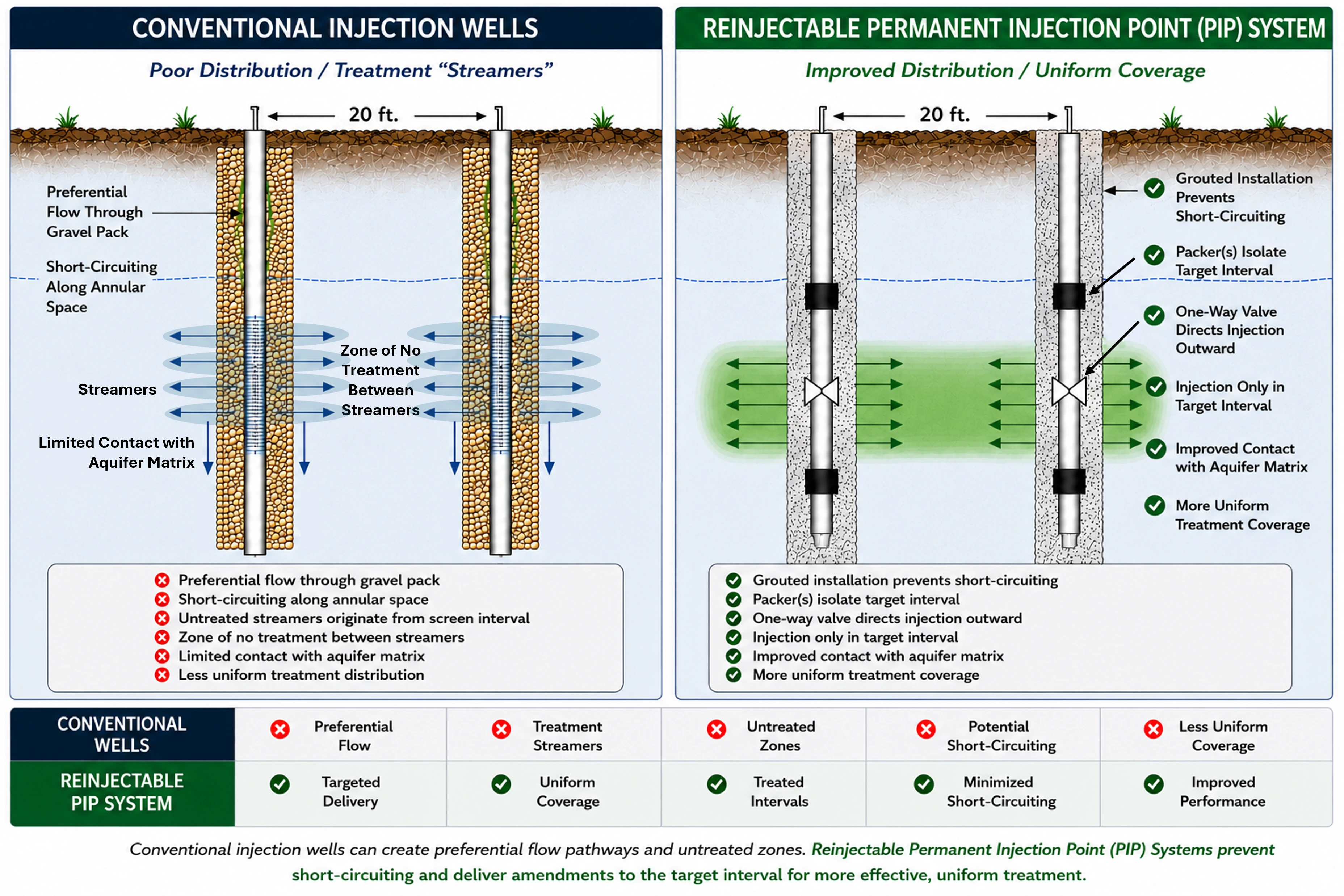
- Target individual treatment intervals.
- Minimize preferential flow and short-circuiting.
- Improve amendment contact with the aquifer matrix.
- Support repeated amendment applications from a single installation.
- Promote more uniform treatment coverage.
- Reduce untreated zones between injection points.
- Lower long-term remediation lifecycle costs
Installation
The Reinjectable PIP System is installed using drilling methods appropriate for site conditions. Following installation, the annular space is sealed with an impermeable grout to prevent vertical migration along the borehole and minimize preferential flow pathways. Injection ports are positioned at site-specific depths based on contaminant distribution, geology, and remediation objectives.
During amendment application, inflatable packers can be used to isolate specific injection intervals, ensuring that injected materials are delivered only to the targeted treatment zone.
TYPICAL APPLICATIONS
The Reinjectable PIP System is particularly valuable for:
- Large chlorinated solvent plumes
- Long-term ERD projects
- Source area treatment zones
- Sites requiring periodic amendment replenishment
- Adaptive remediation strategies utilizing performance monitoring data
The Reinjectable PIP System can be used with a wide range of remediation technologies including:
Enhanced Reductive Dechlorination (ERD)
- EDS-ER™
- EDS-Activator™
- EDS-ME™
- Bioaugmentation Cultures
In Situ Chemical Reduction (ISCR)
- mZVI™
- ZVI-ironGel™
- EDS-ZVI™
Aerobic Bioremediation
Anaerobic Oxidative Bioremediation
Source Area Treatment
- TASK™ Anionic Surfactant Blend
- TASK Soy™
Geochemical Conditioning
Target What Matters Most
Not every portion of a plume requires the same remedial approach. The Reinjectable PIP System supports Tersus Environmental's philosophy of targeting amendments where they provide the greatest benefit, allowing practitioners to selectively inject different products at different depths and at different stages of remediation.
Whether your objective is to Treat, Restore, or Close, the Reinjectable PIP System provides a flexible platform for long-term groundwater remediation.
