
iFLUX Samplers: Measure What Matters Most
Smarter Groundwater Monitoring. Better Remediation Decisions.
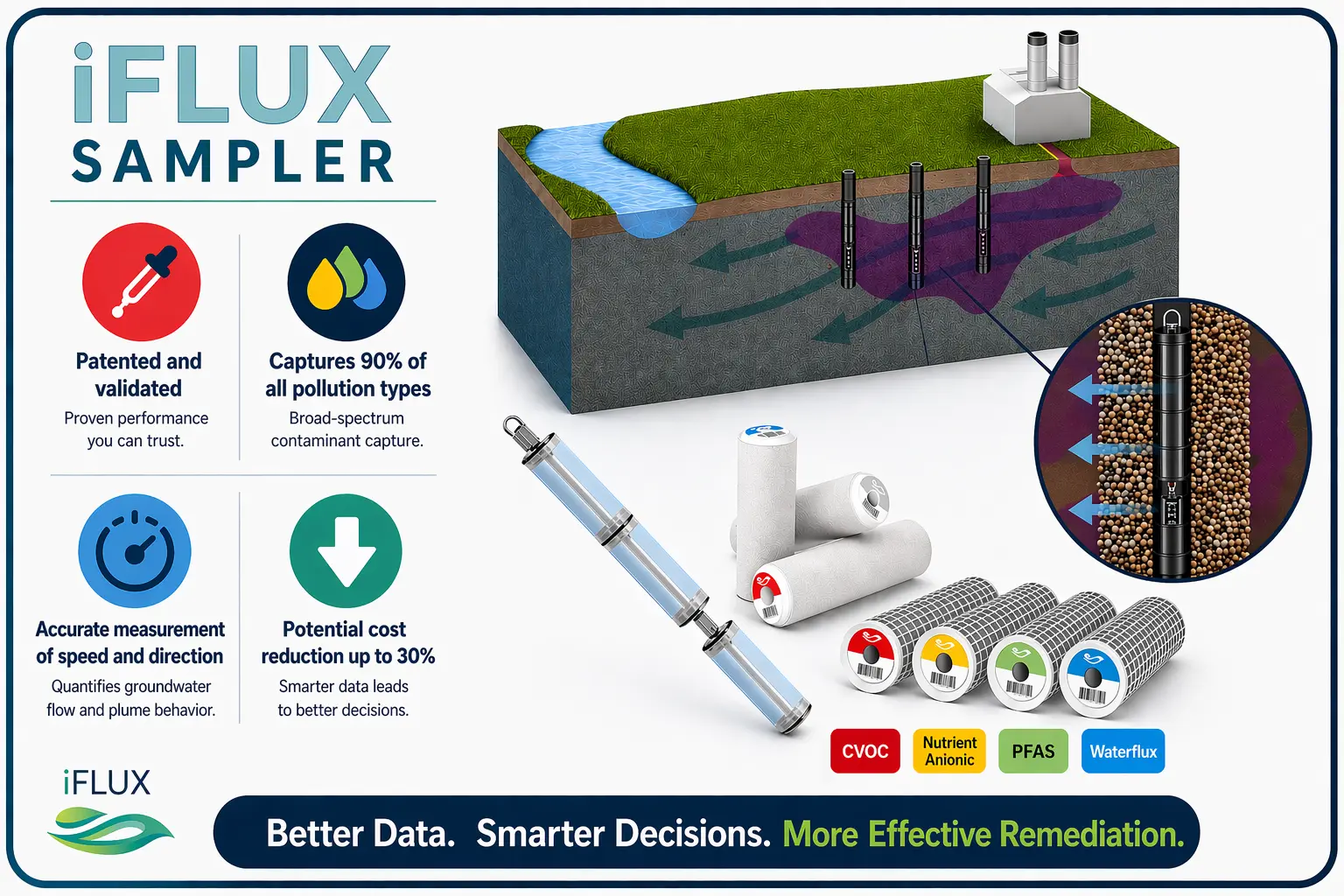
At Tersus Environmental, we are committed to providing technologies that deliver actionable insights into subsurface conditions. One of the most powerful tools available for evaluating groundwater remediation performance is the iFLUX passive flux sampler.
Traditional groundwater monitoring programs often rely on grab samples collected from monitoring wells. While concentration data remain important, these point-in-time measurements often fail to fully characterize contaminant transport and remediation performance.
iFLUX samplers provide time-integrated measurements of both groundwater flow and contaminant transport, allowing practitioners to better understand plume behavior, optimize remedial strategies, and make more informed site management decisions.
The result is a more accurate, defensible, and regulator-friendly assessment of site performance.
Why Flux Matters
When evaluating remediation performance, practitioners have traditionally relied on contaminant concentration trends to gauge progress. However, as noted by the Interstate Technology & Regulatory Council (ITRC), concentration measurements alone cannot answer many of the critical questions necessary to effectively assess and manage contaminated sites.
Traditional grab samples:
- Provide only a snapshot in time.
- Are often influenced by short-term variability.
- Do not quantify the rate at which contaminants migrate through the aquifer.
- Do not determine the actual contaminant mass reaching downgradient receptors.
- May create artificial hydraulic gradients during purging and sampling, potentially mobilizing contamination into the well and biasing results.
- Understanding contaminant mass flux and mass discharge provides a much more complete picture of plume behavior and remedial effectiveness.
Mass-flux-based assessments help practitioners quantify:
- The magnitude of contaminant loading to receptors.
- Relative contributions from different source zones.
- Temporal changes in contaminant loading resulting from remediation.
- Progress toward remedial objectives and site closure.
What Does iFLUX Measure?
iFLUX Samplers measure both:
- Mass Flux – the contaminant mass moving with groundwater flow.
- Groundwater Flux – the volume of water migrating through the aquifer cross-section.
By integrating both parameters, iFLUX provides a dynamic, time-weighted assessment of plume behavior rather than a single point-in-time measurement.
Target What Matters Most: High-Flux Pathways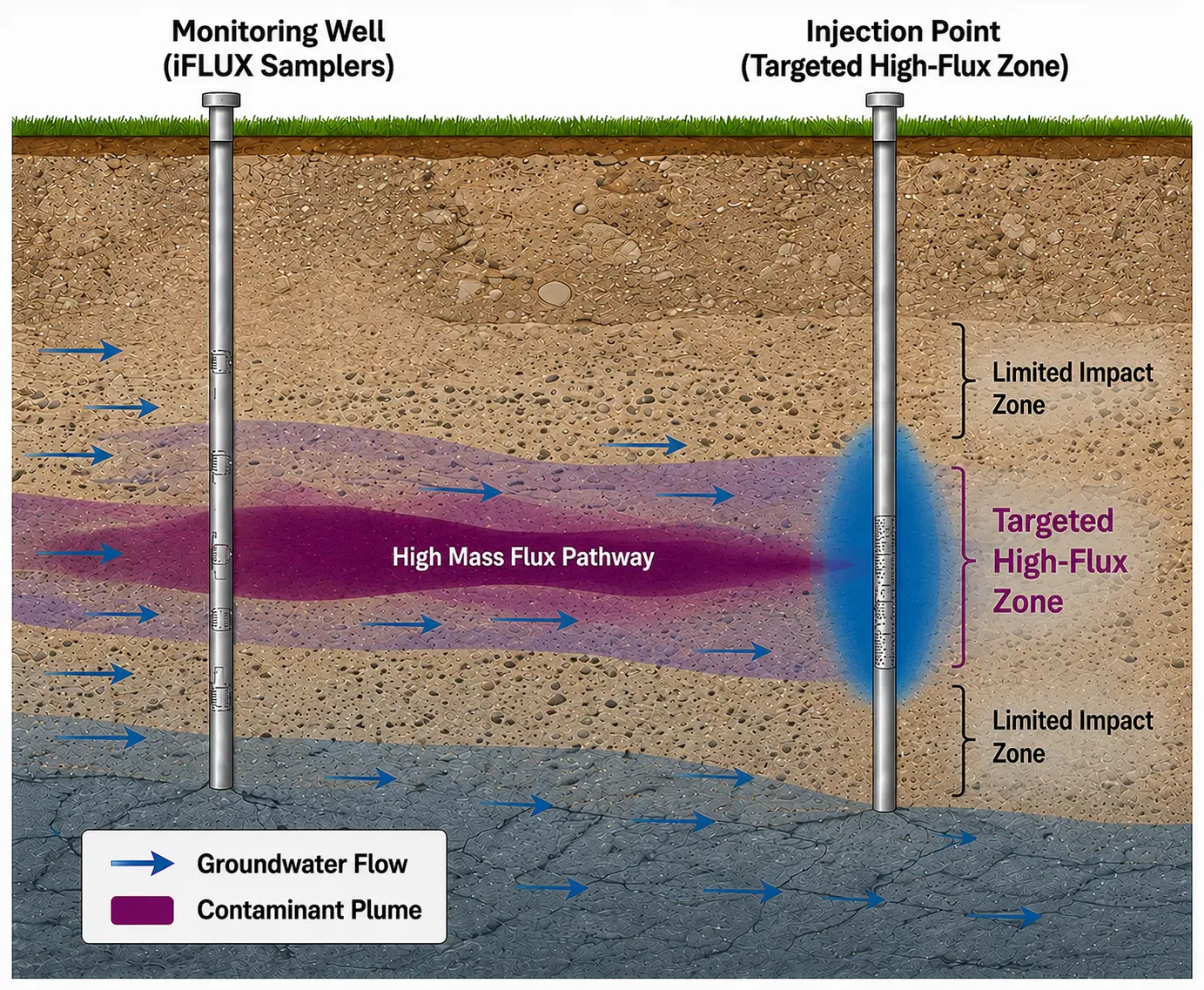
Not all portions of a contaminant plume contribute equally to risk.
In many groundwater systems, a relatively small portion of the aquifer transports the majority of contaminant mass. These high-flux pathways often dominate plume migration and represent the intervals where remediation efforts can have the greatest impact.
Using iFLUX samplers, environmental professionals can identify the discrete intervals responsible for transporting the majority of contaminant mass.
This information can then be used to optimize amendment placement and injection strategies by focusing treatment where it will provide the greatest benefit.
Rather than treating an entire screened interval equally, targeted remediation directs resources to the intervals responsible for the greatest contaminant loading.
Benefits of a Mass-Flux-Based Remediation Strategy
- Improved Treatment Efficiency: Target amendments to the intervals contributing the greatest contaminant loading.
- Reduced Treatment Costs: Decrease amendment requirements and injection volumes by focusing on critical transport zones.
- Enhanced Amendment Contact: Improve contact between remediation amendments and contaminants by treating the most active flow pathways.
- Faster Reductions in Mass Discharge: Achieve greater reductions in contaminant loading by addressing the primary transport pathways.
- Improved Conceptual Site Models: Strengthen conceptual site models by incorporating quantitative groundwater and contaminant transport data.
- Greater Regulatory Confidence: Reduce uncertainty in performance evaluations, risk assessments, and closure strategies.
Applications for iFLUX
iFLUX technology can support:
- Site characterization
- Conceptual site model development
- Remedy design and optimization
- Performance monitoring
- Source area evaluation
- Mass discharge estimation
- Risk assessment
- Remedy transition and site closure
Why Work with Tersus Environmental?
As the North American distributor of iFLUX technology, Tersus Environmental provides:
- Project planning and study design
- Sampler selection and deployment recommendations
- Data interpretation and reporting support
- Training and technical assistance
- Integration of flux data into conceptual site models and remedial strategies
Our team can help you use iFLUX data to improve decision-making, optimize remediation performance, and focus resources where they will have the greatest impact.
Measure What Matters Most
Move beyond concentration-only assessments.
Measure groundwater flow. Quantify contaminant transport. Target high-flux pathways.
Improve remediation outcomes with iFLUX.
Contact Tersus Environmental to discuss how iFLUX can support your next project.
Reference
ITRC (Interstate Technology & Regulatory Council). 2010. Use and Measurement of Mass Flux and Mass Discharge. MASSFLUX-1. Washington, D.C.: Interstate Technology & Regulatory Council.
